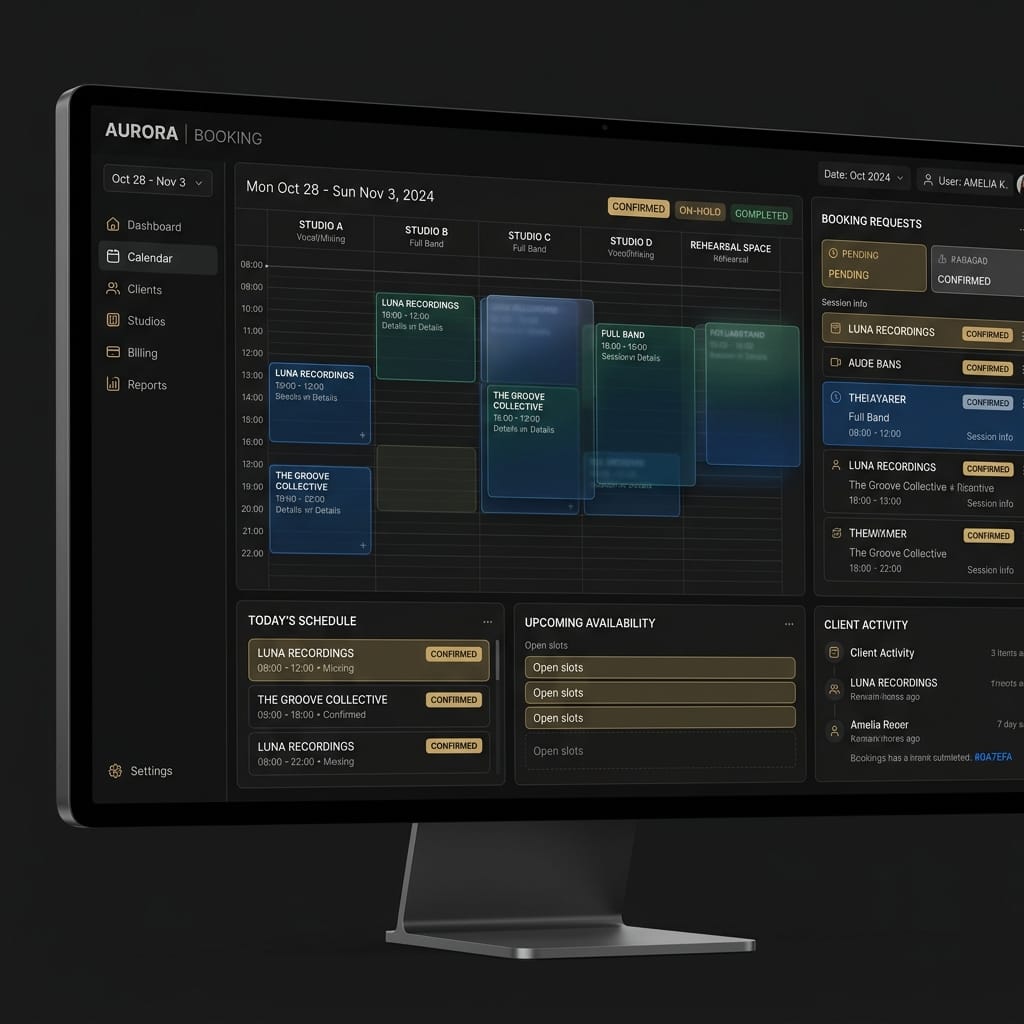
Handling high-volume operational workflows in the creative and wedding industry requires extreme precision. Double bookings, lost invoices, or out-of-sync schedules can cost thousands of dollars.
To solve this, we engineered the Luxima Studio RSVP system—a comprehensive booking, CRM, and asset management engine.
The Operational Bottleneck
Creative studios typically manage their operations through a fragmented stack: Google Calendar for schedules, Excel for CRM, and separate accounting software for invoices. This leads to:
- Data Desync: A calendar change isn't reflected in the invoicing system.
- Manual Overhead: Staff spend hours manually copying data between tools.
- Poor Client UX: Clients receive disjointed emails from different systems.
Our goal was to unify these flows into a single, cohesive engine.
The Tech Stack
- Framework: Next.js 16 (App Router)
- Database: PostgreSQL
- ORM: Prisma Client
- Styling: Tailwind CSS 4
- Real-time: Prisma Pulse / WebSockets
Architecture Deep Dive
graph LR
    Client((Client)) --> |Submits Booking| UI[Booking Engine]
    UI --> |Next.js Actions| API[Server Actions]
    API --> |Prisma Client| DB[(PostgreSQL)]

    DB -.-> |Pulse Event| CRM[Studio CRM]
    DB -.-> |Pulse Event| INV[Invoicing Service]

    INV --> |Generates| PDF[Invoice PDF]
    INV --> |Triggers| Email[Postmark Email]

    classDef core fill:#d4af37,stroke:#fff,stroke-width:2px,color:#000;
    class UI core;
1. Prisma Client for Complex Relational Logic
A booking isn't just a date; it's a web of relations: a Client, a Package, Add-ons, a Studio Room, and an Invoice. We leveraged Prisma's declarative schema to map these complex relations safely.
// schema.prisma
model Booking {
  id          String    @id @default(cuid())
  date        DateTime
  status      BookingStatus @default(PENDING)

  clientId    String
  client      Client    @relation(fields: [clientId], references: [id])

  roomId      String
  room        Room      @relation(fields: [roomId], references: [id])

  invoice     Invoice?

  createdAt   DateTime  @default(now())
  updatedAt   DateTime  @updatedAt
}

enum BookingStatus {
  PENDING
  CONFIRMED
  CANCELLED
  COMPLETED
}
By heavily utilizing Prisma's nested writes, we can create a client, a booking, and an invoice in a single, atomic database transaction. If any part of the process fails (e.g., the room was booked milliseconds prior), the entire transaction rolls back, guaranteeing data integrity.
2. Real-Time Synchronization
When a booking is confirmed, multiple operational nodes need to react instantly. Instead of polling the database, we implemented a real-time sync mechanism using WebSockets (and Prisma Pulse).
When the status of a Booking changes to CONFIRMED:
- The CRM dashboard instantly updates its Kanban board.
- The Invoicing service generates a PDF and flags it as
AWAITING_PAYMENT. - The Calendar UI blocks off the time slot for other users.
3. Server Actions for Form Handling
We migrated away from traditional REST API routes to Next.js Server Actions. This drastically reduced boilerplate and allowed us to execute robust server-side logic directly from our React components.
'use server'

import { prisma } from '@/lib/prisma'
import { revalidatePath } from 'next/cache'

export async function confirmBooking(bookingId: string) {
  await prisma.$transaction(async (tx) => {
    // 1. Confirm the booking
    const booking = await tx.booking.update({
      where: { id: bookingId },
      data: { status: 'CONFIRMED' }
    })

    // 2. Generate the invoice
    await tx.invoice.create({
      data: {
        bookingId: booking.id,
        amount: calculateTotal(booking),
        dueDate: generateDueDate()
      }
    })
  })

  // Purge Next.js cache to reflect changes globally
  revalidatePath('/dashboard/bookings')
}
Conclusion
The Luxima Studio RSVP system proves that operational complexity can be abstracted into an elegant, fast, and reliable interface. By relying on PostgreSQL for ACID compliance and Next.js Server Actions for seamless client-server communication, we eliminated manual data entry and reduced booking errors to absolute zero.